
How to Get Court Records
Begin with the court and cause number. A quick search of the El Paso County records hub and Odyssey will surface entries. Jot down the exact docket line or document title you need. From there, custody follows the court type. District civil, family, felony, juvenile, and appellate clerk records sit with the District Clerk. County-court-at-law misdemeanor and civil-probate files sit with the County Clerk. Justice and municipal courts keep their own papers.
Search online first, then lean on re:SearchTX as a backup. Phone works too: District Clerk at 915-273-3534, County Clerk at 915-273-3532. You can also walk in at 500 E San Antonio, Suites 103 or 105. Ask about inspection or a public terminal. Pick the right channel, whether mail, email, fax, Customer Service, criminal-copy, civil-probate, or a PIA form. Say plainly whether you want to inspect, a plain copy, or a certified copy. Choose your delivery. Set a maximum amount where that is allowed.
- Identify the court, cause number, and exact record.
- Choose Odyssey, counter, phone, mail, email, fax, or the matching request form.
- Submit party names, dates, division, and document title.
- Review the estimate and pay through an accepted method.
- Receive the plain or certified copy and preserve its certification.
Types of Court Records
District files in El Paso County can include civil pleadings, family filings, felony instruments, and appellate clerk records. Juvenile material is governed by access rules. County Clerk files hold misdemeanor criminal papers plus probate-civil documents. A probate request might name an application, a will, an admission or appointment order, an inventory, an oath, proof of death, a waiver, bonds, MERP material, or a certification.
Criminal requests can point to a complaint affidavit, an indictment or charging instrument, a plea agreement with waivers. They might also name a final judgment or dismissal, or another titled item. Want a transcript? That sits with the court reporter, not the clerk. No single transcript fee or turnaround is published. Exhibits demand a call to the responsible court, since custody and sealing vary case by case.
- Case files and chronological docket sheets
- Signed judgments, orders, and dismissals
- Public misdemeanor and felony criminal documents
- Civil and family pleadings subject to access limits
- Probate applications, wills, inventories, oaths, and bonds
What a Court Record Contains
A docket row is only the surface. The register tells you what exists, but the document you request supplies the substance, and a full file can hold far more than the index shows. Protected identifiers may be redacted under Texas Rule 21c. One case can also carry both public and sealed parts, so expect a mixed file.
| Case Number | The local cause number and assigned court. |
|---|---|
| Pleadings | Petitions, motions, answers, and charging papers. |
| Orders & Judgments | Signed rulings, judgments, dismissals, or sentences. |
| Docket Sheet | The chronological register of filed and court events. |
| Exhibits | Filed evidence or attachments when public and retained. |
Certified Copies and Fees
A plain copy just reproduces the record. Certification is a separate service the clerk performs, and the County Clerk criminal form prints the clearest local copy prices. Payment comes due before release. Processing can run up to 48 hours, and an unpaid request closes after 10 days. Amounts shift, so verify current figures because payment notices differ.
| Item | Amount |
|---|---|
| Plain copy | $1 per page |
| Certification | $5 per document |
| Search without case number | $5 |
| Background letter | $6 |
| Extra name or last name | $5 |
Public Access and Sealed Records
Case records answer to court-access law and orders, not to open-records rules written for agencies. Courts sit outside the Texas Public Information Act. That law binds executive branches instead. Rule of Judicial Administration 12 covers judicial records other than case records. Rule 21c shields sensitive data. Rule 76a governs civil sealing. Expunction, nondisclosure, juvenile, adoption, and family statutes layer on more limits.
Key rules:
Texas judicial open-records policy distinguishes court case records from agency records.
Texas Rule 21c requires sensitive-data redaction in filings.
Code of Criminal Procedure Chapter 55 governs expunction.
A PIA request cannot lift a court seal. Ask the clerk or the court which motion, order, identity proof, or relationship proof controls access to the record.
Three El Paso Record Layers
Three layers make up a court record. The docket is the chronological index. The filed document is the petition, motion, order, judgment, exhibit, or charging paper behind an entry. A certified copy carries the custodian's certification, and none of these layers substitutes for another. A visible docket entry promises no free document image.
| Layer | Contents | Route |
|---|---|---|
| Docket | Events and settings | Odyssey or clerk search |
| Document | Text or image behind entry | Portal or copy request |
| Certified copy | Official clerk-certified copy | Custodian request and fee |
Need only one order? Ask for its exact title and date rather than "the whole case."
El Paso Criminal Copy Form
The County Clerk copy form asks for your contact details, delivery preference, case number, certification choice, defendant name and birth date, document type, and an optional letter. Payment is due before the clerk releases anything. Anyone charging a company card must attach an authorization letter. The County Clerk page shows the division structure. You can confirm where your request lands.
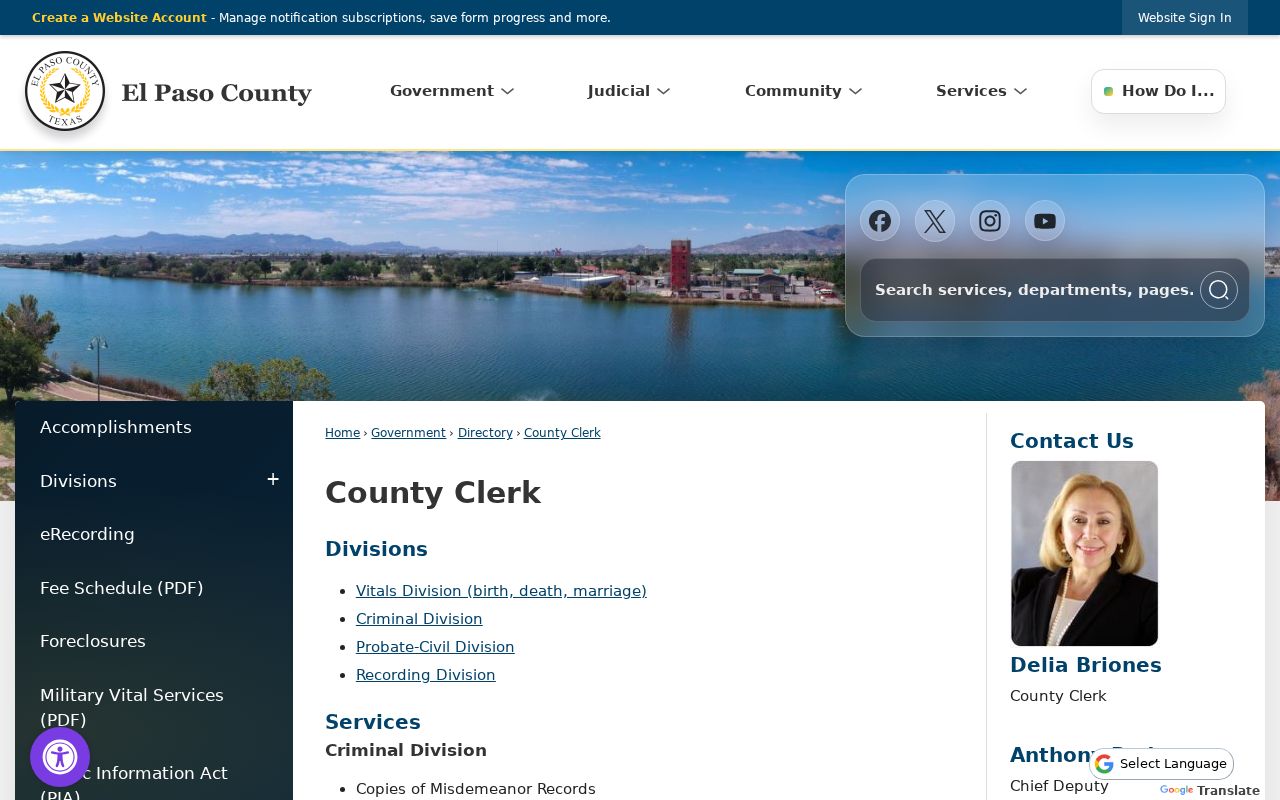
The split helps route misdemeanor and probate-civil copies to the correct desk.
El Paso Civil Probate Delivery
The civil-probate form offers pickup, USB, U.S. Mail, CD, email, and Dropbox delivery. You will list the record type, copy count, and an amount not to exceed. The description should include names, events, department, and dates. Give the exact docket title and keep the date range narrow.
Paying a County Clerk PIA request can run through business checks, cashier's checks, money orders, and major cards. The PIA page states a $1.95 convenience fee and 2.25% over $87. That differs from other county card language. Confirm the current rate before you pay.
Older El Paso Paper Files
Odyssey examples prove nothing about a first searchable year. For an older El Paso County case, bring names, the court, a cause number if known, and a date range. Ask whether the file sits in paper. Ask about microfilm, archives, or removal under a retention schedule. No universal cutoff appears on official county pages.
One caution: the city FullCourt pre-2006 purge statement covers that municipal system alone, not all El Paso County court records. Each custodian answers for its own series, so ask yours directly.
El Paso Court Reporter Transcripts
A transcript records what was said in court. For availability, price, and preparation time, contact the court reporter rather than the clerk. No single transcript fee is published. No single turnaround is either. So request a current estimate from the reporter assigned to that court and date.
Do not confuse the transcript with the docket entry showing a hearing occurred. Exhibits may follow separate custody or sealing rules of their own. Name the proceeding, then ask the assigned court which office holds each item.
Describe an El Paso Record Request
Start with the basics. A strong request description names the cause number and the court. Then add full party names. Add the filed or hearing date, and the exact title of the docket entry you want. Probate asks for something more specific. Name the application, will, order, inventory, oath, bond, or certification. A misdemeanor report works best with a date range. Add any class, offense code, or disposition fields you need. Pick a delivery method. If the form has a box for a maximum charge, fill it in.
Keep the scope tight so staff can actually find the record. Payment may be required before anything is released. The County Clerk PIA page says a response comes within 10 business days. That word is not a promise every court document arrives that fast. Sealed files can slow the process down. Statutory limits, archive searches, unpaid estimates, or court review can too. If your request is denied, ask for the denial in writing and for the right court procedure. And leave Social Security numbers and other sensitive identifiers out of any broad request.
Hold onto the clerk's receipt, the delivery message, and the certification along with your copy. If the pages you receive do not match the docket title you asked for, go back to the same division. Give them the cause number and your request record before you start a second search.
Split Custody in El Paso
The District Clerk and the County Clerk hold different files. The District Clerk's public page covers district civil, family, felony criminal, juvenile, appeals, and related clerk work. Its criminal division assigns new criminal suits and pleadings. It coordinates pre-indictment work with the Jail Magistrate, issues warrant numbers, and stores criminal files. Its appeals division builds clerk records for the Eighth Court of Appeals and any other authorized appellate review. The County Clerk's criminal division, meanwhile, handles misdemeanor copies, while Probate-Civil keeps the probate and civil records. The County Clerk's PIA page links separate civil-probate and criminal request forms. That split works well for county records and reports. The Texas Public Information Act is no workaround. It does not defeat a judge's seal or the court rules that govern case files.
Read a denial or a limited release closely. Ask which office has custody. Ask whether the item is a court case record or another kind of judicial record. Ask whether a statute or an order blocks release. When access turns on your identity or relationship, follow the procedure the clerk gives you. Adoption records sit under especially tight limits. The District Clerk needs enough child, case, and adoptive-parent information to judge whether you may see them.
For inspection, ask what public counter process exists. The county offers in-person access. It does not promise a set number of terminals or a staff-assisted station. Old files may sit in archived storage, so ask. Keep any certification intact and never alter the record. For transcripts, get current terms from the assigned reporter. Each of these questions keeps your request with the office that can truly fulfill it.